
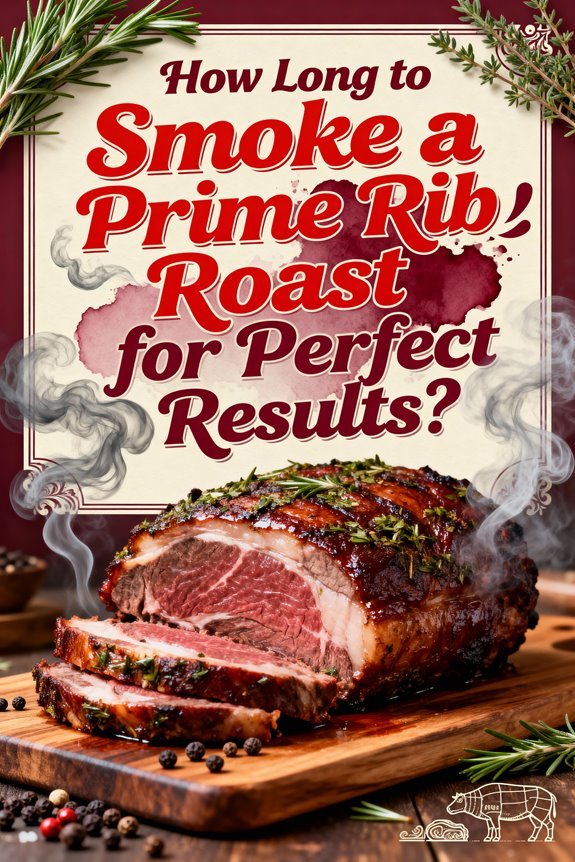
You’ll need 30-40 minutes per pound when smoking prime rib at 225°F, or 20-30 minutes per pound at 250-275°F. For a typical 6-pound roast, expect around 4 hours at lower temps. Pull your roast at 120-125°F for rare or 130-135°F for medium-rare—it’ll rise another 10°F during rest. Factor in an additional 45+ minutes for resting and optional reverse searing. The breakdown below covers wood selection, preparation techniques, and timing adjustments that’ll guarantee restaurant-quality results.
Understanding Smoking Temperature and Time Guidelines
When you’re smoking a prime rib roast, temperature control directly determines both your cook time and final results. The ideal range spans 225°F to 275°F, with each end offering distinct advantages. At 225°F to 235°F, you’ll achieve gentle smoke penetration and even cooking, but expect approximately 35-40 minutes per pound. Raising your smoker to 250°F-275°F cuts this to roughly 20 minutes per pound while promoting better bark formation. Most 8-12 pound roasts require 2.5 to 3 hours before searing. Your internal temperature targets matter equally—pull the roast at 120°F-125°F for rare or 130°F-135°F for medium-rare, always 5 degrees below your goal to account for carryover. These smoking techniques require consistent monitoring with a leave-in probe thermometer for precision. Much like perfectly smoked burgers, maintaining proper temperature control is essential for achieving the desired doneness and juiciness. Wood selection significantly impacts the final flavor profile, with options including apple, hickory, pecan, oak, and mesquite available for experimentation. Similar to proper freezing methods, letting the roast cool completely before storing any leftovers helps maintain its quality and prevents temperature fluctuations in your freezer.
Calculating Cook Time Based on Roast Weight
Your prime rib’s weight serves as the foundation for calculating total smoking time, though it’s only one variable in the equation. At 225°F, multiply your roast’s pounds by 35-40 minutes—a 6-pound roast requires approximately 4 hours. Higher temperatures accelerate this: 250°F drops to 30 minutes per pound, while 275°F cuts it to 20. These cook weight calculations provide your baseline, but time estimation demands flexibility. A 10-pound roast at 225°F needs roughly 6.6 hours, yet smoker efficiency and ambient conditions alter results. Don’t forget rest and sear phases—they add 45+ minutes beyond per-pound estimates. Similar to smoking tri-tip, you should allow for a 15-20 minute rest before slicing to ensure proper juice distribution. Like brisket smoking, you may encounter a temperature stall around 150-160°F where cooking temporarily slows. Always budget extra time; a finished roast holds beautifully in a cooler, but rushed cooking compromises quality. Track actual results to refine your personal timing formula. A meat thermometer remains essential for tracking doneness regardless of calculated cooking times.
Internal Temperature Targets for Different Doneness Levels
Precision thermometry separates exceptional prime rib from overcooked disappointment. You’ll need an instant-read thermometer to master temperature management across doneness levels. For rare, pull your roast at 115°F to 120°F. Medium-rare requires 125°F to 130°F—the sweet spot for most enthusiasts. Medium sits at 135°F to 140°F, while medium-well reaches 145°F. Well-done isn’t recommended, but it’s anything above 150°F.
Here’s the critical part: insert your thermometer into the thickest section, avoiding fat and bone for accurate readings. During resting, expect a 5°F to 10°F temperature rise. Similar to brisket preparation, low and slow cooking helps break down the meat’s connective tissues effectively. Like brining poultry, applying a butter or oil coating helps lock in moisture during the smoking process. These doneness techniques demand consistency. Cover your roast with foil and let it rest 15 to 20 minutes—this allows muscle fibers to relax and juices to redistribute throughout the meat. For optimal results, maintain your smoker at 225°F throughout the cooking process to ensure low and slow heat penetration.
Preparing Your Prime Rib Before Smoking
Before you fire up the smoker, proper preparation determines whether your prime rib emerges tender and flavorful or dry and disappointing. Start by trimming fat from the cap, leaving a quarter-inch layer for moisture and flavor. Remove silver skin and connective tissue with a sharp knife to prevent uneven cooking. Similar to the low and slow method used in brisket smoking, careful preparation is essential for prime rib success.
Tying roast sections with kitchen twine maintains shape and promotes uniform heat distribution. If you have a bone-in roast, remove and tie back the bones for easier cooking while still benefiting from their protective qualities. Similar to grilling a tomahawk, allow the meat to reach room temperature for about an hour before cooking. Apply olive oil or mustard as a binder, then press your seasoning blend firmly into all surfaces, including the ends. For deeper flavor penetration, wrap the seasoned roast and refrigerate overnight.
Remove it from refrigeration 30 minutes before smoking to guarantee even cooking. Insert your probe thermometer into the thickest section, avoiding fat pockets for accurate readings. Consider applying a flavorful herb paste made with fresh garlic, rosemary, thyme, and sage mixed with extra virgin olive oil.
Seasoning and Binding Techniques for Maximum Flavor
Since prime rib’s rich marbling provides built-in flavor, your seasoning strategy should amplify rather than mask the beef’s natural qualities. Dry rubs benefits include simplicity and robust penetration—coarse kosher salt and black pepper form the foundation, while garlic powder adds depth. Herb crusts advantages emerge when you blend fresh rosemary, thyme, and garlic with olive oil, creating aromatic complexity that complements smoke. Just as low and slow cooking produces perfectly melted cheese, this gentle approach allows seasonings to fully penetrate the meat.
Mustard slathers serve dual purposes: they create tackiness for spice adhesion and contribute tangy caramelization during smoking. Apply your chosen binder generously, pressing firmly into all surfaces, including under the fat cap. This flavor binding technique guarantees seasoning penetrates beyond the exterior. Like smoked sausage storage, proper wrapping of leftover prime rib in airtight containers helps maintain freshness and flavor for several days.
For ideal results, dry brine overnight—salt’s osmotic action tenderizes while drawing moisture that later evaporates, forming exceptional bark and concentrating flavors throughout. You can safely cook directly from refrigeration, which actually enhances smoke absorption compared to bringing meat to room temperature.
Setting Up Your Smoker and Monitoring Temperature
When smoking prime rib, your success hinges on establishing and maintaining a rock-solid 225°F to 250°F environment before the meat enters the chamber. Similar to lid closed grilling, keeping the smoker covered helps maintain even cooking temperatures throughout. Preheat your smoker with the lid closed for 15 minutes, ensuring temperature stability through proper smoker airflow control. Position the roast on the center grate away from direct heat, placing an aluminum drip pan underneath to catch drippings.
Insert a digital leave-in probe into the thickest section for continuous monitoring—you’re targeting 130-135°F for medium-rare. Use wireless thermometers to check progress without opening the lid unnecessarily. Similar to smoking brisket, using a remote temperature probe helps minimize lid openings that disrupt cooking. Expect 30-35 minutes per pound at 225°F. Adding a water pan in your smoker helps maintain humidity levels throughout the cook, preventing the exterior from drying out. Once you hit 100-120°F internally, crank the heat to 400-500°F for a final sear that develops a proper crust.
Choosing the Right Wood for Smoking Prime Rib
The wood you choose fundamentally shapes your prime rib’s final flavor profile, transforming a simple roast into a complex, smoke-infused centerpiece. Oak delivers balanced, earthy notes that won’t overpower your beef’s natural richness. Hickory provides bold, bacon-like smokiness but requires restraint—too much creates bitterness. Pecan offers sweet, nutty complexity ideal for extended smokes, while cherry adds subtle fruitiness and a beautiful mahogany crust.
Understanding wood flavor profiles is essential for success. Mesquite burns intensely hot and risks harshness unless blended carefully. You’ll achieve superior results through smoking wood combinations—pairing oak’s steadiness with cherry’s brightness or tempering hickory’s punch with pecan’s sweetness creates nuanced depth. Match your wood’s burn characteristics to your smoking duration: oak and pecan sustain longer sessions, while cherry complements shorter applications. Always use dry, seasoned wood rather than green wood to avoid releasing unpleasant chemicals during the smoking process. For optimal smoke absorption, maintain a steady cooking temperature between 225°F and 250°F throughout the session. Like with smoking ribs, consider using apple juice spritz periodically to maintain moisture and enhance flavor development.
When to Remove Your Roast From the Smoker
Perfect smoke flavor means nothing if you pull your prime rib at the wrong moment. You’ll need to remove the roast at 10°F below your target doneness—typically 120°F for medium-rare—since carryover cooking will raise the temperature another 5-10 degrees during rest.
The reverse sear method can be applied to finish your prime rib after smoking for enhanced crust development. Use a leave-in probe positioned in the thermal center, away from bone and fat, for accurate readings. Don’t rely on visual cues alone. When your alarm sounds at the smoker removal point, verify with a secondary instant-read thermometer. Similar to a butcher paper wrap used for brisket, covering your prime rib helps retain moisture during the final stages.
Plan for a 15-30 minute rest period under loose foil. This allows juices to redistribute while internal heat equalizes. For a roast smoked at 225-250°F, expect roughly 30-40 minutes per pound to reach your smoker removal temperature. High-temp alarms help you monitor critical temperature thresholds and prevent overcooking during the smoking process.
Resting and Reverse Searing for a Perfect Crust
After your prime rib reaches its target temperature in the smoker, you’ll face a critical decision: serve it with a soft exterior or transform it into something exceptional with reverse searing. Proper resting techniques require 20–45 minutes off-heat, allowing juices to redistribute while internal temperature rises 3–5°F through carryover cooking.
Remove your roast 5–10°F below target doneness to account for this rise and the upcoming sear. Pat the surface completely dry before applying high heat at 450–500°F for 10–15 minutes. Cast iron skillets, broilers, or direct grill zones work perfectly for crust formation. Similar to achieving crisp fish skin when grilling trout, the high heat creates an appealing texture and rich flavor. A flavorful garlic-herb rub applied before smoking will enhance the final crust development during the searing process.
The sear adds another 3–5°F internally while creating a caramelized exterior through rapid Maillard reaction. The thick fat cap will render beautifully during this final sear, creating additional flavor while helping achieve that coveted crispy crust. No additional rest needed—serve immediately while the meat’s hot and the crust crackles.
Total Time Estimates From Prep to Plate
Planning your entire cook requires accounting for multiple stages that compound into significant kitchen time. Your pre smoker checklist includes trimming, seasoning, and preheating—roughly 30 to 45 minutes before the roast enters the chamber. Once smoking begins at 225-250°F, you’ll need approximately 35-40 minutes per pound to reach medium-rare doneness. For an 8-pound prime rib, that’s about 4.5 to 5 hours of active smoking time. Similar to brisket smoking, using a water pan helps maintain moisture throughout the extended cooking process. Testing for doneness with a probe thermometer ensures the same reliable results as smoking brisket.
After removing the roast, factor in 20-30 minutes for resting, allowing juices to redistribute and internal temperature to rise. If you’re reverse searing for crust development, add another 15-20 minutes. Your complete cooking timeline spans 6 to 7 hours from initial prep through final plating—plan accordingly to serve at your target mealtime. For optimal flavor penetration, consider applying a dry brine 24 to 48 hours before you begin the smoking process.