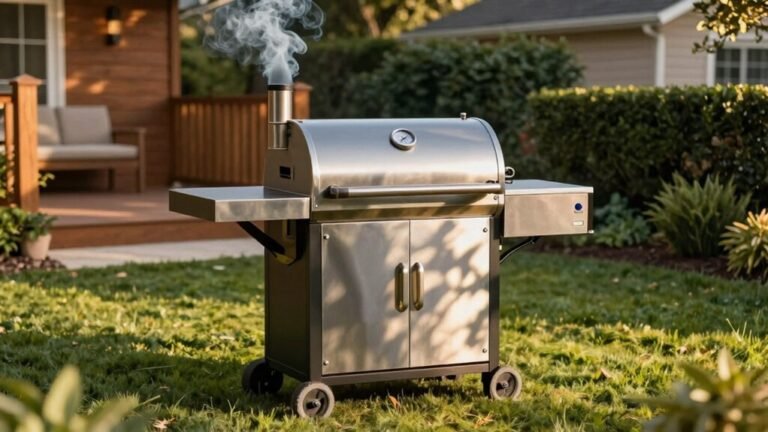


You’ll find the Camp Chef Woodwind Pro delivers the best balance of WiFi-enabled precision and true wood-fired flavor for backyard competition, while the Yoder Smokers YS640S dominates with 10-gauge steel construction and 700°F searing capability if budget permits. Mid-range options ($500-$1,200) now feature PID controllers maintaining ±5°F accuracy—essential for consistent bark formation and smoke penetration. Your hopper capacity (22+ pounds minimum) and dual-wall insulation matter more than flashy apps when you’re targeting overnight brisket cooks. The specifications below break down exactly which features justify premium pricing versus marketing hype.
Top-Rated Pellet Smoker Models for Your Backyard
When you’re ready to elevate your backyard BBQ game, the Camp Chef Woodwind Pro stands as 2024’s top-rated pellet smoker for good reason. Its WiFi-enabled controller delivers precise smoke and temperature regulation, while four probe ports let you monitor multiple cuts simultaneously. The best pellet smokers offer versatility—this model accepts wood chunks and charcoal alongside pellets for enhanced flavor complexity. Just like with grilling steaks, using internal temperature control helps achieve perfect doneness every time.
For competition-level performance, the Yoder Smokers YS640S features heavy 10-gauge steel construction and reaches 700°F for serious searing. Budget-conscious pitmasters should consider the Pit Boss Mahogany at $699, delivering solid performance without compromise. Among top models, the Grilla Grills Alpha Connect excels in compact spaces while maintaining compatibility with premium Bear Mountain hardwood pellets, offering hickory, mesquite, and fruit wood profiles for precise flavor control. The Traeger Ironwood XL connects with mobile devices for monitoring, making it easy to track your cook from anywhere in the house. For perfect results when smoking chicken, maintain a steady 250-degree temperature for approximately one hour per pound of meat.
Understanding Price Points: From Budget to Premium Options
Budget pellet smokers under $500 deliver functional performance for backyard enthusiasts, though they sacrifice the precision temperature control and construction quality that competitive pitmasters demand. When conducting pellet smoker comparisons, you’ll find mid-range units ($500-$1,200) like the Grilla Grills Silverbac AT offer WiFi connectivity and expanded cooking capacity. Premium options ($1,200-$2,500) feature advanced PID controllers that maintain ±5°F accuracy—critical for consistent bark development and smoke ring formation. Most models include prime function capability to ensure proper pellet ignition and prevent startup errors. For optimal food safety when smoking fish, models with vacuum sealing options can help extend storage life up to two weeks in the refrigerator. Price point analysis reveals luxury models ($2,500-$4,000) incorporate commercial-grade stainless steel and sophisticated airflow systems that optimize wood pellet combustion. High-end value options like the Rec Tec Flagship 1100 bridge the gap, delivering competition-worthy temperature stability and robust construction without premium pricing. Reviewing detailed comparison charts helps identify which features and specifications matter most for your specific grilling needs. Your investment should align with your wood-smoking expertise level and competitive ambitions.
Essential Features That Make a Difference
Price determines which features you’ll access, but specific technologies separate smokers that merely function from those that win competitions. Dual temperature sensors maintaining ±5°C accuracy prevent the fluctuations that ruin low-and-slow briskets. Auto-tuning fuel systems compensate for wind and cold, while PID controllers eliminate guesswork. Smoke retention hinges on felt gaskets and dual-wall construction—features that intensify flavor penetration during critical initial hours. Grease management isn’t optional; slotted pans with dedicated buckets prevent fires and simplify post-cook cleanup. High-capacity hoppers (28-40 lbs) enable overnight cooks without refilling, and pellet dump mechanisms let you switch from hickory to cherry mid-session. Manual feed options accelerate startup for searing applications. Stainless components and robust frames guarantee longevity, while app-connected controls provide real-time monitoring when you’re managing multiple proteins simultaneously. Models with multiple meat probe ports allow simultaneous monitoring of different cuts at various stages of doneness. For optimal results with chicken drumsticks, look for smokers capable of dual temperature ranges that can start low at 225°F and finish high at 375°F for crispy skin. Unlike traditional offset smokers, which require mastering airflow control through vents and dampers, pellet smokers automate temperature regulation for consistent results.
Cooking Capabilities: Smoking, Grilling, and Beyond
While entry-level models coast by on 180°C ceilings suitable only for pulled pork, competition-grade pellet smokers deliver 315°C+ searing zones that transform ribeyes into steakhouse-quality centerpieces. You’ll master advanced smoking techniques through PID controllers maintaining ±2° precision across 12-hour brisket sessions, while 28-pound hoppers eliminate mid-cook refueling. The reverse sear method ensures perfectly cooked steaks by gradually smoking at low temperatures before finishing with an intense sear.
SmokeBoost technology intensifies flavor penetration during cold smokes, then you’ll pivot to high-heat grilling methods for competition-worthy bark development. Premium units function as outdoor ovens—roast vegetables at 190°C, bake pizzas at 260°C, or braise short ribs using indirect convection. Digital interfaces toggle between low-and-slow and reverse-sear protocols seamlessly. Some models even include a grilled sandwich setting perfect for achieving golden-brown crusts and evenly melted cheese.
WiFi-enabled meat probes synchronize doneness alerts with automatic temperature adjustments, letting you execute complex multi-zone cooking while blending hickory and cherry pellets mid-session for layered smoke profiles. Top-tier models include built-in induction cooktops that expand your outdoor kitchen capabilities beyond traditional grilling and smoking.
[affiai keyword=”competition grade pellet smoker wifi” template=”carousel” count=”3″
Build Quality and Design Elements to Consider
A pellet smoker’s structural integrity determines whether you’re nursing temperature swings mid-brisket or maintaining rock-solid 107°C stability through overnight cooks. Prioritize 10-gauge steel construction—it’s the threshold where durable materials shift from backyard-adequate to competition-grade heat retention. Fully gasketed lids aren’t optional; they’re essential for smoke density and fuel efficiency during 16-hour pork shoulder sessions. Similar to cedar plank grilling, maintaining consistent temperatures ensures optimal moisture retention and flavor infusion in your meats. Like smoked turkey preparation, the right equipment makes all the difference in achieving that perfect lacquered exterior while keeping the interior moist.
Evaluate hopper capacity against your typical cook duration: 18-pound hoppers require mid-cook refills, while 28-pound systems handle overnight burns. Front-mounted hoppers with pellet dump features simplify flavor shifts between hickory and cherry profiles. Design aesthetics matter less than functional elements—look for PID controllers maintaining ±2.7°C accuracy, direct-flame grilling options, and robust wheel assemblies supporting 90kg+ loaded weights. Kansas-built American construction consistently delivers superior fit-and-finish over overseas alternatives. Premium models in the $3800 price range offer enhanced durability and advanced features that justify the investment for serious outdoor cooks.
[affiai keyword=”heavy duty pellet smoker with large hopper” template=”carousel” count=”3″
User-Friendly Technology and Long-Term Support
Modern pellet smokers separate themselves through controller intelligence that directly impacts your competition results—PID algorithms maintaining ±1.4°C stability eliminate the temperature swings that ruin bark formation on championship briskets. Smart connectivity enables real-time adjustments during overnight cooks, with app-based alerts preventing catastrophic pellet depletion at hour twelve of your cook cycle.
Like digital probe thermometers for turkey smoking, firmware updates deliver measurable improvements: updated algorithms reduce pellet consumption by 15-20% while maintaining smoke quality. Multi-probe systems track internal temps across four brisket flats simultaneously without heat loss from lid opening. The low and slow cooking method typically requires 1.5 to 2 hours per pound at 225°F for optimal results.
User feedback consistently ranks hopper capacity (22+ pounds minimum) and cleanout accessibility as critical for competition schedules. Manufacturers providing extended warranties on electronic components demonstrate commitment beyond initial sale—essential when your WiFi module controls $200 worth of wagyu. Hybrid models incorporating electric heating coils alongside traditional pellet systems unlock both low-temperature smoking and high-heat searing capabilities in a single unit.
[affiai keyword=”wifi enabled smart pellet smokers” template=”carousel” count=”3″